


This Shanghai travel guide has everything you need to know for a fuss-free trip in 2026!

Last updated: 15 May 2026
There was once a time when most people wouldn’t consider China as a travel destination, but that couldn’t be any different from today.
The country’s experiencing a travel boom, and the city of Shanghai is reigning as a vacation hotspot — it’s modern, bustling, and one of the most foreigner-friendly ones in the country.
Still, adequate planning is much needed when travelling there, especially since the city (and country) has their own set of apps, advanced technology, and cultural norms. So here’s our Shanghai travel guide for 2026, with tips and tricks to navigate the beautiful city!
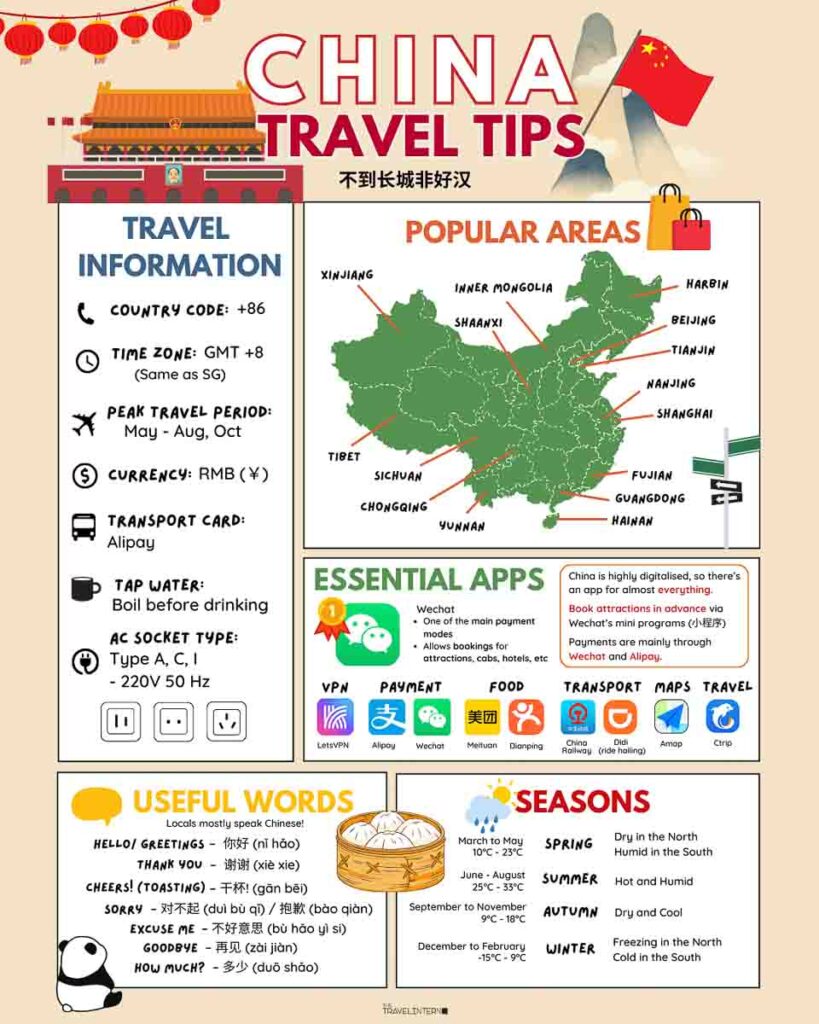
Planning your trip
Best time to visit Shanghai

China has four seasons, and each brings a different look and vibe to the city. We went during sakura season, which fell between mid-March to end-April. (Psst… if you’d like to see the blooms, check our socials for yearly Sakura forecasts! 😉)
We recommend going during the off-peak seasons because crowds in China during the holidays are unbearable. For public holidays, definitely avoid Golden Week (October 1–7) which is when the country celebrates its National Day. The exact dates for Chinese holidays can be found on this website.
| Months | Peak or Off-peak? | Any extra dates to avoid? |
| Jan – Feb | Peak period (winter school holidays) | New Year’s Day Chinese New Year |
| Feb – Jun | Off-peak period | Qingming Festival Dragon Boat Festival |
| Jul – Aug | Peak period (summer school holidays) | |
| Sep – Dec | Off-peak period | Golden Week Mid Autumn Festival |
Click read more to see how Shanghai’s monthly weather and season is like!
Must-visits and day trips from Shanghai

There are plenty of things to do in the cosmopolitan city, from sightseeing to shopping and eating. Here are some of our favourite activities:
Pampering our inner child at Shanghai Disneyland

The happiest place on earth never fails in bringing a smile to faces, no matter your age. The whimsical and magical place has plenty of rides, character meet and greets, and performances to keep everyone entertained.
For tips on how to conquer Shanghai Disneyland, read our article here!
Skiing at Yaoxue Ice & Snow World

The largest indoor ski park in the world, Yaoxue Ice & Snow World lets you experience a winter wonderland no matter the time of the year. Besides skiing, you can also enjoy the Snow World where there’s plenty of indoor rides!
Exploring Zhujiajiao Water Town and Guangfulin Cultural Relics Park

For a breath of fresh air away from the city, take a day trip to Zhujiajiao Water Town or Guangfulin Cultural Relics Park.
Both places hold a lot of history and retain their cultural heritage really well. Walking along the beautiful canals of the water town or strolling down the scenic streets of Guangfulin is really peaceful.
Read also: 7D6N Shanghai Itinerary — New and Lesser-known Places Beyond The Bund and Disneyland

And don’t forget to visit other nearby cities as well! Thanks to China’s railway system, it’s way easier and faster to travel to neighbouring cities now.
Some cities that are worth a day trip from Shanghai are Hangzhou (tranquil lakeside scenery), Suzhou (classical gardens), and Nanjing (historical landmarks).
Read also: 2-Week China Itinerary — Rail Adventure Across Beijing, Shanghai, Hangzhou and Suzhou
Things to prepare for Shanghai
1) Get an eSIM or data passport with VPN

One question that we’re always asked regarding China travel is: “Should I get an eSIM, or a local number?”
And our answer to that is, it depends.
If you’ve already pre-booked everything and don’t plan on booking anything new through local apps, an eSIM would suffice. We got ours from Klook and it came with built-in VPN, so we were able to access all US-based apps (except TikTok).
*Pro-tip: Redeem 5% OFF Klook for use later, up to 3x. Just enter code <THETRAVELINTERNKLOOK> at checkout. New users get 10% OFF their first booking. T&C’s apply!
Meanwhile, if you’re on a trip with the intention of booking activities through China’s local apps like Meituan or WeChat, a local SIM would be more useful since you’ll need a number for contact details.
You’ll also be able to reach local merchants through direct phone calls, and have no issue when registering for apps or services (like when ordering at a milk tea store). However, this requires going to an official Telco store (China Mobile, China Telecom, China Unicom) and registering for a number using your passport, which might be a hassle.
*Pro-tip: If you’re getting a local SIM, we recommend LetsVPN as a reliable VPN option!
2) Set up your payment apps in advance

99% of places in China are cashless, so it’s a must to install WeChat Pay or Alipay. Simply link your multi-currency card or credit card to the apps, and you’ll be good to go.
Another alternative is Changi Pay, which we explored further in this article here. It’s accepted amongst merchants who accept Alipay in China, has competitive exchange rates, and you don’t need to have a China bank account to register.
We didn’t get to use Changi Pay on our trip, but we heard that it helps you avoid the 3% fee for transactions above RMB200 — something that’ll definitely come in handy when you’re on your shopping spree 🛍
3) Download WeChat
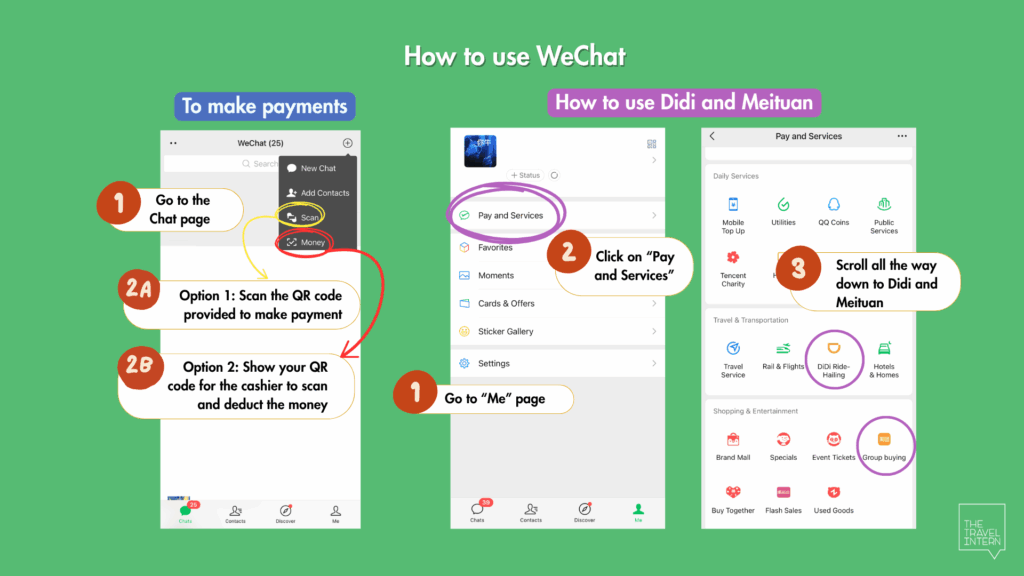
If I were stranded in China and had to use only ONE app, it’d be WeChat.
This multi-functional app is the main messaging platform in China, with mini-programmes that let you access services from external apps like Meituan and DiDi, as well as a built-in payment function.
So technically, you don’t really need the other Chinese apps — you could search them up and use them on WeChat.
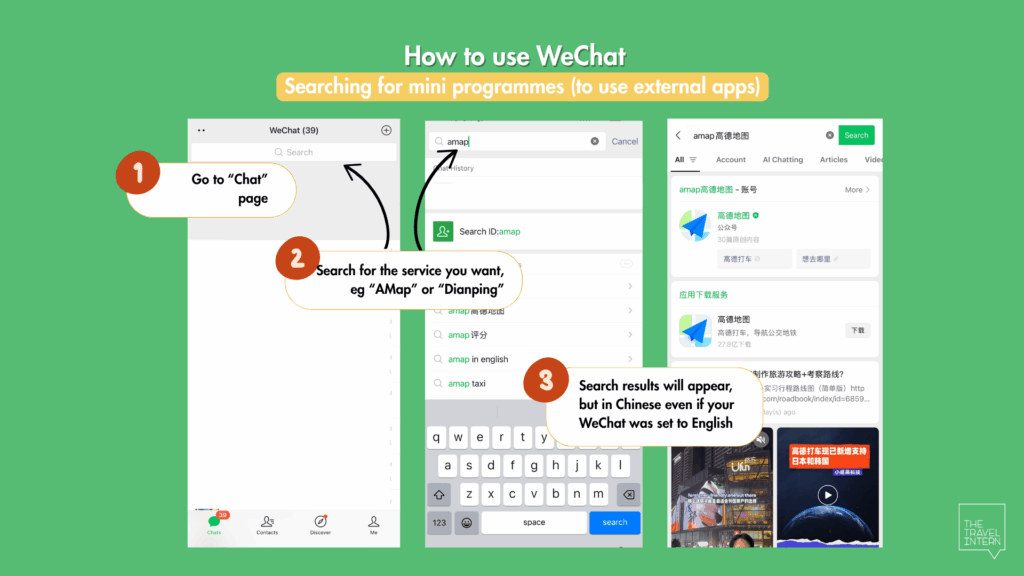
That said, I personally think it’s still good to download the apps on your phone, instead of using WeChat to access them.
That’s because when you use its mini-programmes, you won’t receive notifications and updates if you exit out of the app. That can be an issue when, let’s say, you’re booking a ride on DiDi through WeChat and miss the notification that the driver has arrived.
Moreover, the mini-programmes might be difficult for people that aren’t familiar with Chinese, as the search interface will still be in Chinese even if you’ve set the language settings to English.
Still, having the app will definitely come in handy in other situations: when you have to pay, contact merchants, or scan a QR code to order in stores/restaurants.
4) Pre-book your activities and accommodations

Since Shanghai is a popular city, most activities might get crowded and accommodations can run out of rooms! That’s why it’s always good to book them in advance.
For activities: Book via Klook, or directly via the WeChat mini programmes.
*Pro-tip: Redeem 5% OFF Klook activities for use later, up to 3x. Just enter code <THETRAVELINTERNKLOOK> at checkout. New users get 10% OFF their first booking. T&C’s apply!
For accommodations: Book on OTAs like Klook, Booking.com, or Trip.com. You can also use local apps like CTrip for homestays and service apartments.
*Note: When booking on local travel apps, take note that some accommodations only cater to Chinese locals, so always check if the accommodation you’re booking accepts foreigners. Otherwise, you will get kicked out (this happened to the writer once…)
That being said, this applies more for hostels and some service apartments/homestays, and not so much for established hotels.
5) Bring the correct power bank!

Here’s one very important thing to note about bringing a power bank: ensure that the power capacity does not exceed 100Wh (~27,000mAh), and that it is clearly stated on the device.
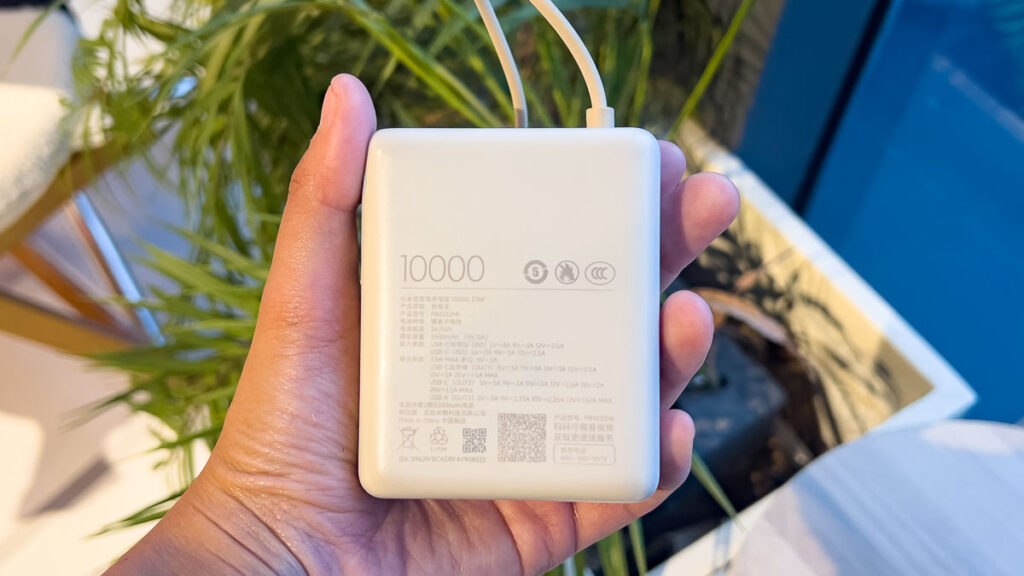
In addition, a clearly visible CCC (China Compulsory Certification) is required on power banks on domestic flights and layovers within China, even if they are under the capacity limit.
If there’s no such indication or the words are illegible, it will be confiscated. We’ve lost a few power banks from this in the past, so don’t be like us! 😭
Getting around Shanghai
1) Download AMap to navigate Shanghai

Google Maps isn’t useful in Shanghai as it doesn’t show all the shops or places in the city. We suggest using AMap instead, China’s own version of Google Maps. It comes in English as well.
Besides showing you directions, it also lets you save locations in the app!
2) Take the bus or metro to save money
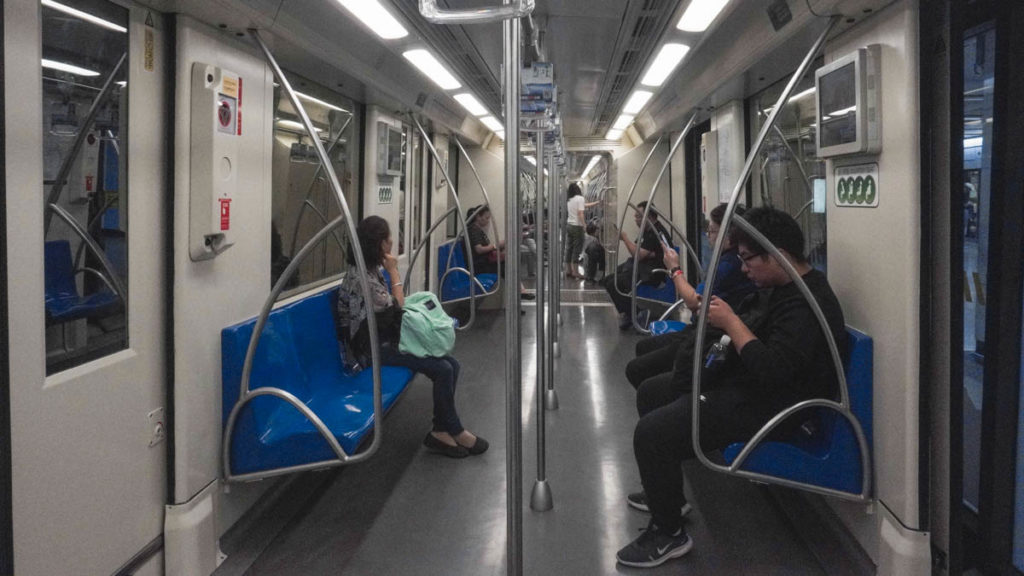
Shanghai’s public transport system is highly convenient, easily accessible, and cheap. Metro rides can cost as low as RMB3 (~S$0.20).
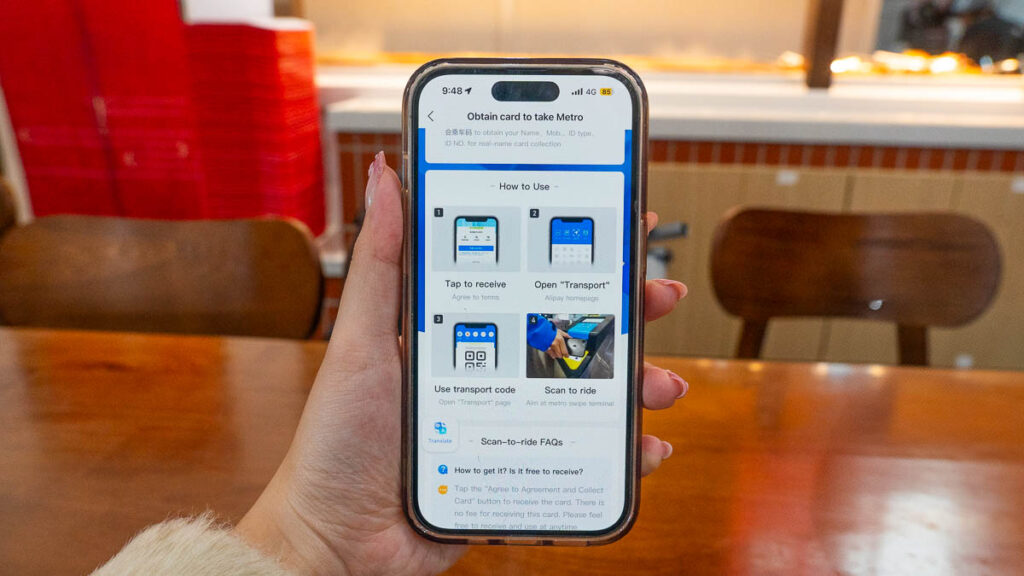
Bank cards aren’t accepted for public transport, so get the e-transport card on the Alipay app. It’s free, and you can use it for both metro and bus.
You’ll need to first link a bank card to your Alipay app. Then, open your Alipay app > Click on Transport > Select and confirm the transport card you want.
There’s also the option of buying metro tickets from the machine, or paying by coins for the buses. For trains, take note that there’s a mandatory security check when you enter the station.
3) Take DiDi when you’re in a rush
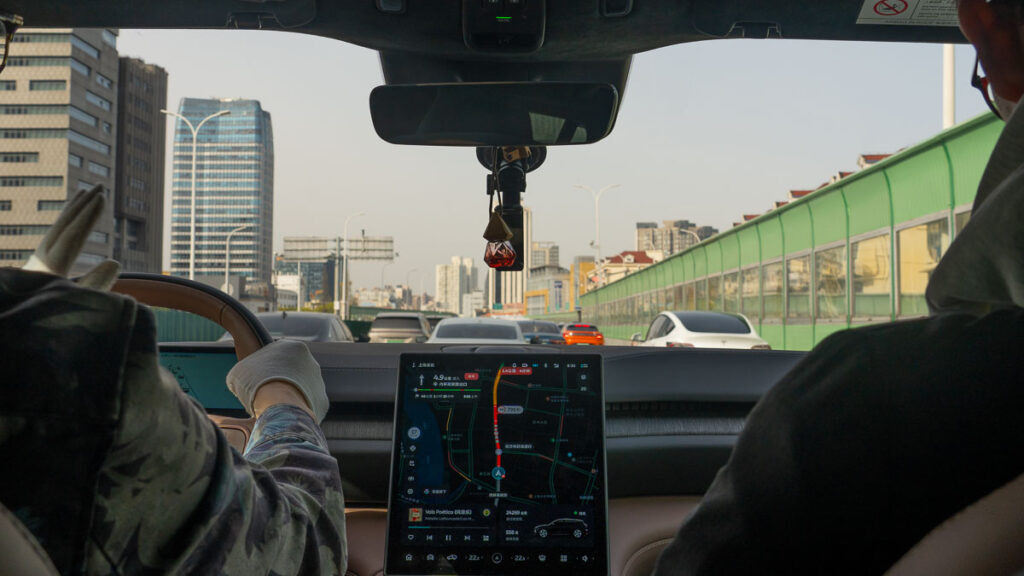
DiDi is an affordable and convenient ride-hailing service in China, although it’s generally advised to avoid the peak hours as traffic can get congested. You can download the app (iOS / Android) , or book via Alipay or WeChat.
Drivers usually call their customers upon arrival, but that won’t work if you’re using an eSIM. So text them via the app’s chat function, to tell them that you can’t be reached by call, and prefer to text instead.
This was what we texted our driver when we were in Shanghai — feel free to copy!
师傅您好,我的电话打不通,到了可以在这儿回复我。谢谢!
(Translation: Hello, I am uncontactable by calling. Please text me here once you’ve arrived. Thank you!)
In Shanghai
1) Download a translation app

Majority of locals in Shanghai speak only Chinese, which means there could be a language barrier if you aren’t familiar with the language. We used Google Translate when we came across some difficult phrases.
For navigation, most road and metro signs have an English name.
To help our non-Chinese speaking friends, here’s a table of useful phrases that you can refer to when you’re in China!
| English phrase | Chinese phrase (with hanyupinyin) |
| Hello | 你好 / Nǐ hǎo |
| Thank you | 谢谢 / Xièxiè |
| Excuse me | 不好意思 / Bù hǎo yì si |
| Sorry | 对不起 / Duìbùqǐ |
| Can you speak English? | 你会说英文吗?/ Nǐ huì shuō yīngwén ma |
| How do I get to…? | 请问我怎么去…? / Qǐngwèn wǒ zěnme qù …? |
| Where is the …? | …在哪里? / … zài nǎlǐ? |
| This is delicious! | 好吃 / Haǒchī |
| I cannot eat… For Muslim friends: I cannot eat pork | 我不能吃… / Wǒ bù néng chī 我不能吃猪肉 / |
| For Muslim friends: I can only eat halal food | 我只能吃清真食品 / Wǒ zhǐ néng chī qīngzhēn shípǐn |
| How much is this? | 多少钱? / Duōshǎo qián? |
| This | 这个 / Zhège |
| That | 那个 / Nàgè |
2) Use Meituan for late night supper delivery
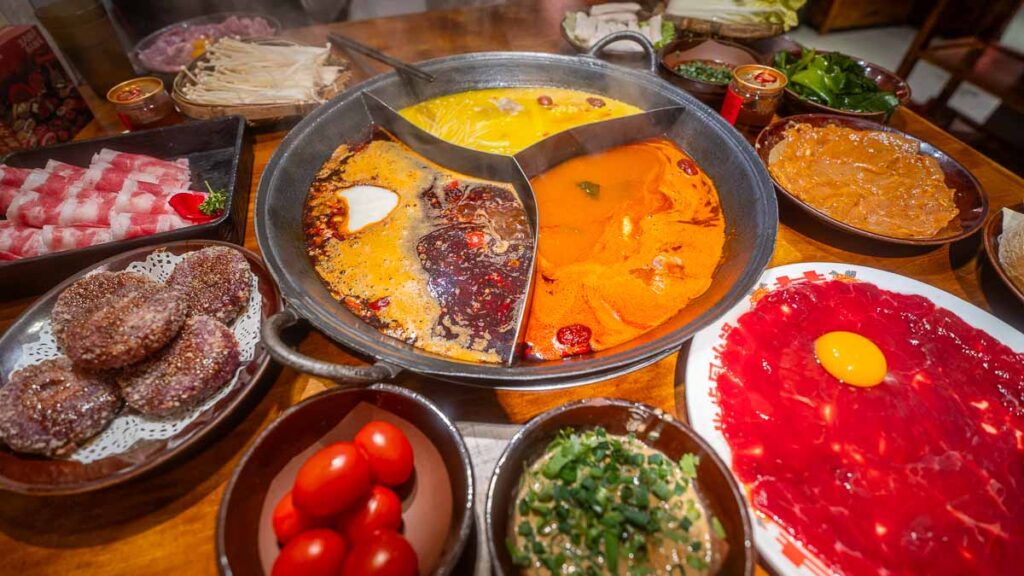
Save the trouble of going out for supper, and order in via Meituan instead. You can download the app, or use its mini programme in WeChat (open WeChat > Me > Pay and Services > Group buying, under Shopping & Entertainment).
*Pro-tip: You need to have a Chinese number to place an order. If you don’t have one, ask your hotel’s front desk for help.
Another method that we heard (but didn’t get to try) is to use a random generated Chinese number, and notify your delivery person to contact you via Meituan’s in-app function.
3) Indulge in delicious local food!

Shanghai is a food heaven where mouthwatering delicacies where you can find congyoubing (scallion pancakes), xiaolongbaos (soup dumplings) and shengjianbaos (pan-fried dumplings).
We’ve made a Shanghai food guide for some must-try food. For more recommendations, check out the Michelin bib gourmand, or search up restaurants on the Dianping app (大众点评). The latter also gives you food discounts at an incredible deal!
For our Muslim friends, search for halal restaurants (translation: 清真餐厅) on Dianping or Rednote.
*Note: There is no tipping culture in China!
4) Do your shopping in the Xintiandi-Anfu Road area

One regret I have is not doing enough shopping in Shanghai. There’s way more variety over there than you can get in Singapore!
Two shopping districts we explored were Xintiandi and Anfu Road. There are plenty of independent boutiques and well-known brands in these two areas, like Gentle Monster, Wiggle Wiggle, Jellycat, and Deja Vu (多抓鱼循环店) . Our favourite has to be the last one, as they sold good quality second-hand clothes and books that were as cheap as S$6!

For food options, we tried the New York Bagelous Museum at Xintiandi (which has delicious bagels), and Cafe 13De Marzo at Anfu Road where they give you a cute bear along with your drink.
5) 打卡 culture in China

The art of 打卡 (taking pictures for social media) is super strong in China, and probably uncontested across the globe. As such, many tourist attractions like The Bund and Wukang Mansion will have independent photographers advertising their services to visitors.
A picture typically costs around RMB5 or more, and photographers usually help with posing as well. They’ll edit on an iPad and print out the picture immediately.
We never got our picture taken by the street photographers, but we did copy from them when we were at Wukang Road to get a good angle for our photo 😉
Apps to download when in China

While it may seem daunting at first, travelling in China can be really easy if you have done enough prep work, and the key is really just downloading the right apps.
Here’s the apps you’ll need!
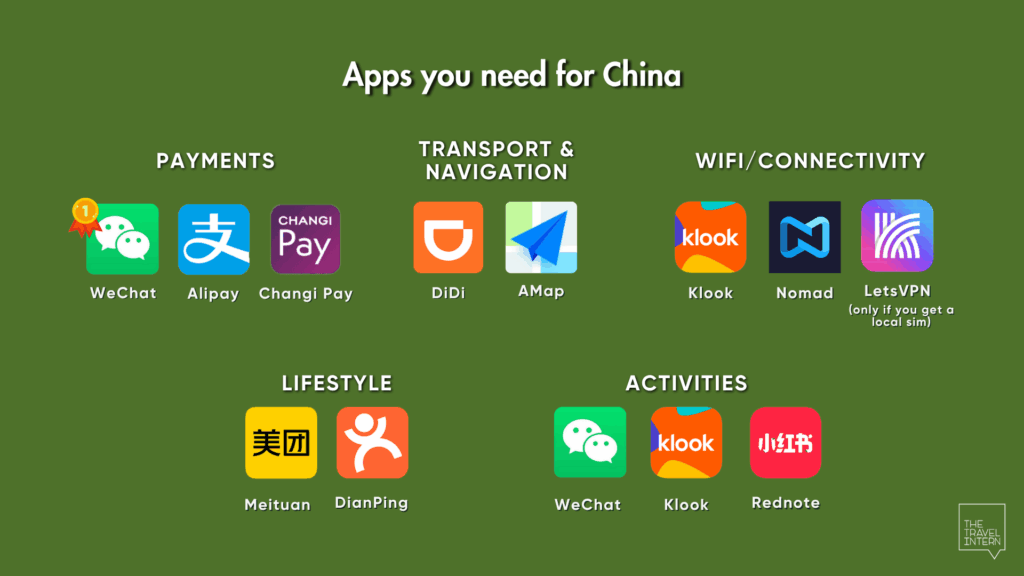
| Function | App |
| WiFi/Connectivity | eSIM (Klook / Nomad) LetsVPN (if you’re getting a local sim) |
| Payment | Alipay (支付宝) WeChat (微信) Changi Pay |
| Transportation & Navigation | DiDi (滴滴) Amap (高德地图) |
| Lifestyle (incl. food delivery, restaurant discounts, local vouchers, and attraction tickets) | Dianping (大众点评) Meituan (美团) |
| Activities | Klook WeChat (微信) Rednote (小红书) |
*Pro-tip: For Klook, use code <THETRAVELINTERNKLOOK> to get 5% off, up to 3x.
Other travel guides for Shanghai

To help you plan your Shanghai trip, here are some guides that we think will come in handy!
– 7D6N Shanghai Itinerary — New and Lesser-known Places Beyond The Bund and Disneyland
– 25 Exciting Things to Do in Shanghai — First Timer’s Guide From Must-Dos to Hidden Gems
– Shanghai Food Guide — 15 Mouth-Watering Dishes You Won’t Regret
– Ultimate Shanghai Disneyland Guide — 11 Tips & Tricks To Beat the Crowd (2025)
*Pro-tip: Another super useful app to have is Rednote (AKA Xiaohongshu). There are tonnes of recommendations for activities to do, places to go, and foods to eat! They also have an in-app translation function, which is definitely helpful for reading the Chinese posts.